
For most of the last decade, “TV gaming” meant consoles. Smart TVs and streaming sticks had app stores, and those stores had games, but almost nobody in the industry took them seriously.
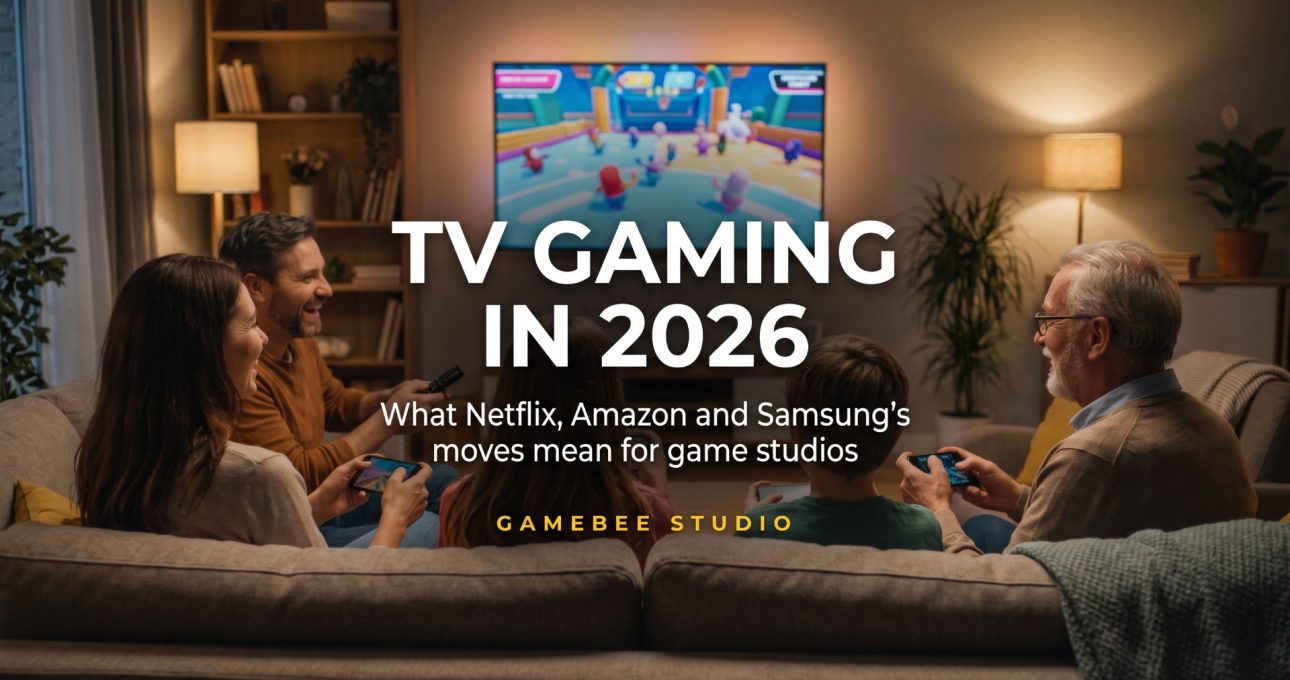
That changed in the last twelve months. Three of the biggest companies in the living room have all made the same bet: casual, social games played on the TV, without a console.
At Gamebee Studio we have been building games for smart TVs, especially Amazon Fire TV, since 2019. Here is what we see happening, and what we think it means for studios.
What the big platforms are doing
Netflix made cloud-based TV games one of its priorities for 2026. It added a Games tab to its TV app, launched party games such as Boggle, Pictionary and LEGO Party!, and in April 2026 added three Jackbox games. Players use their phones as controllers. Netflix has said roughly a third of its members can access TV games so far.
Amazon relaunched its Luna cloud gaming service around GameNight, a collection of 25+ party games played with a phone, included with Prime. In July 2026 it went further: Prime members on Fire TV in the US and UK can now launch Luna games from inside the Prime Video app.
Samsung says casual and party games are driving growth on its Gaming Hub, which now offers access to thousands of games on its smart TVs.
Three different companies, three different business models, one conclusion: the TV is becoming a place where families play together again.
Why the TV, and why now
- The screen is already there. Amazon says its Appstore reaches more than 250 million devices, across Fire TV and Fire tablets. Nobody needs new hardware.
- Phones make great controllers. Scanning a QR code is easier than pairing a gamepad. That removes the biggest barrier TV gaming always had.
- Short, social sessions fit the living room. People don’t sit down to play for three hours on a smart TV. They play a round, pass the remote, laugh, and play again.
What still makes TV gaming hard
It would be dishonest to call this easy. Building for TVs has real problems mobile developers don’t face:
- Weak hardware. Many TVs and streaming sticks have far less memory than a budget phone. Games have to be built light.
- The remote. Most players will never connect a controller. If a game doesn’t work with a D-pad and one button, most living rooms can’t play it.
- Discovery. TV app stores are harder to browse than phone stores, and search is limited.
- Fragmentation. Fire TV, Google TV, Samsung Tizen, LG webOS and Roku all work differently. Every platform is its own port.
- Monetisation. Payment details are rarely tied to the TV, so in-app purchases are harder than on a phone. Ads and subscriptions carry more of the weight.
What we’ve learned building for the TV
- Design for the remote first, not last. If a 60-year-old can’t play it with four arrows and a select button, it isn’t a TV game.
- Make it readable from three metres away. Big text, big buttons, high contrast.
- Keep rounds short. The living room is full of interruptions.
- Build once, then adapt per platform. A shared core with thin platform layers is the only way to keep up with fragmentation.
- Go where others aren’t. On Fire TV, more than half of the downloads of our Fire games in October 2026 came from TV devices, not tablets. That audience is real, and far less crowded than the phone stores.
What this means for game studios
If you make casual, sports, racing or party games, the TV is no longer a side project. The platforms are now investing to put games in front of their viewers. Studios that already know how to build for remotes, small memory budgets and short sessions are the ones those platforms will want to work with.
For Indian studios in particular, this is an opening. India has world-class casual and mobile game talent, and very few studios here are building for TVs first.
About Gamebee Studio
Gamebee Studio is an independent, self-funded game developer and publisher based in Mumbai, India, founded in 2019. It has published 70+ games across smart TV, mobile and PC, on Amazon, Google, Apple and other platforms.
Sources: Netflix Q4 2025 earnings commentary (PocketGamer.biz, StreamTV Insider); Amazon Games, “Prime Video is getting games via Amazon Luna” (23 July 2026); Outlook Respawn (Luna relaunch; Netflix Jackbox titles); GamesBeat (Samsung Gaming Hub); Amazon Developer (Appstore device reach).