
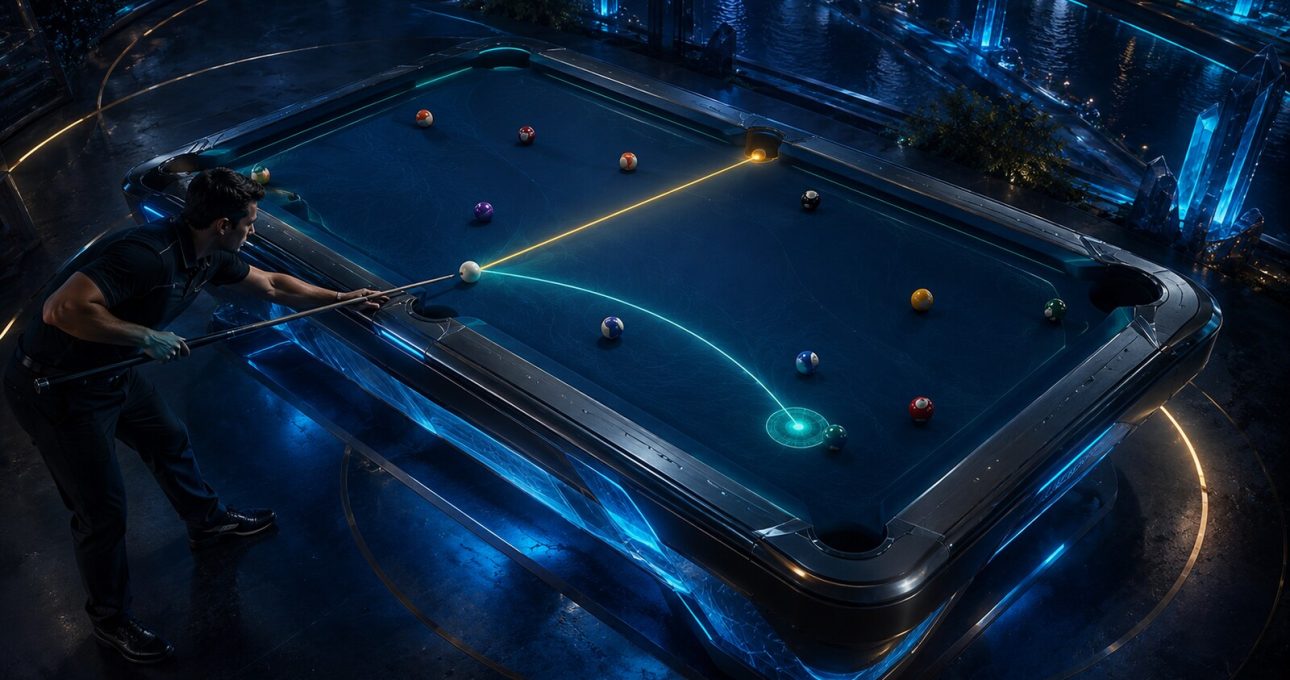
Pool Masters Pro is a 3D 8-ball game about choosing a line, controlling power and leaving the cue ball ready for the next decision. The verified Apple edition supports real-time PvP, tournaments, touch input, Pass & Play, trick-shot puzzles and offline solo practice on iPhone and iPad.
Android TV uses a separate package and the display name Pool Masters 3D: Multiplayer. It emphasizes a television remote, local two-player Pass & Play, online competition and solo trick shots. The shared pool identity is strong, but device, mode and purchase differences must remain visible throughout the review.
One product family serves two different screen contexts
Apple presents Pool Masters Pro – Multiplayer as a mobile billiards app, while Google positions Pool Masters 3D: Multiplayer for Connected TV. The exact names help players understand why a search may show different results and why one generic download button would be less useful than labeled platform choices.
The website can connect both records through the P36 family, but every practical claim should retain its edition. Mobile touch precision is not evidence for a TV gesture, and remote support does not describe an iPhone control. Progress or purchases should not be assumed to move between stores.
8-ball turns every successful shot into a position problem
Both public descriptions center the game on pool and 8-ball competition. Pocketing the current ball matters, but the more revealing quality test is whether the player can understand where the cue ball travels next. Readable aim, power and collision feedback make a rack feel strategic rather than arbitrary.
A useful opening test uses a simple line and moderate force. If the object ball follows the expected path and the cue ball's finish can be explained, the control loop is ready for more complex position play. The sources describe realistic physics without publishing a complete simulation model.
Online multiplayer adds pressure to the shot routine
Apple names real-time one-on-one PvP and global tournaments, while the Android TV record describes real-time online opponents, leaderboards and online tournament play. Those claims establish a competitive context, but they do not guarantee matchmaking time, opponent availability, rank rules or reward values in every territory.

The strongest multiplayer experience preserves the same pre-shot sequence under pressure: inspect the table, choose the contact line, set power and check the next position. A fast opponent should not force an unreadable decision. Network conditions and current event rules still need a live check before a planned match.
Pass & Play makes one device a shared table
Both checked listings describe local two-player Pass & Play. On Android TV, the shared television naturally supports a room-based session; Apple describes two players using one mobile device. Confirm how turns, input handoff and any account or purchase prompts behave in the edition selected.
A good shared setup agrees on rules before the break and changes hands only when the turn is complete. This reduces accidental input and keeps attention on the table. Public descriptions do not establish every rule variation, controller count or household entitlement, so inspect the current mode screen first.
Trick shots isolate geometry from full-rack pressure
Apple presents hundreds of trick-shot puzzles, and Google names solo trick-shot challenges on Android TV. These modes can focus attention on cushions, collision order and cue-ball placement without requiring the strategic breadth of an entire competitive rack. Exact challenge counts should stay edition-specific.

Judge a trick shot by the clarity of its objective and feedback. The player should understand the required outcome, see why an attempt failed and make a narrower correction. A difficult puzzle remains fair when its geometry can be learned rather than solved through repeated unexplained power changes.
Touch input and a TV remote require separate calibration
Apple describes swipe aiming and a mobile power bar. Google names intuitive TV remote support for aim, spin and power. A close touchscreen can support fine gestures, while television play adds viewing distance and a different input device. Neither context is automatically more precise for every player.
Use three straight shots at increasing visible power to learn the chosen edition before judging a difficult rack. Watch whether the line can be adjusted without overshooting and whether the power response remains predictable. Do not copy sensitivity, button or gesture instructions from the other platform.
Offline use belongs to the Apple evidence only
Apple explicitly describes offline 8-ball solo practice. The Android TV listing confirms solo trick-shot challenges, but it does not clearly state that they work without a connection. A solo mode and an offline promise answer different questions and should not be treated as synonyms.
Players who need connection-free practice should verify the Apple edition after installation and confirm which activities remain available. Television players should assume connectivity may be required until the exact build proves otherwise. This distinction prevents a useful Apple feature from becoming an unsupported family-wide promise.
Customization and purchases need practical boundaries
Both descriptions refer to cues, table themes or other customization. Apple also exposes subscriptions, coin packs, cue unlocks, advertising and in-app purchases. These elements can extend collection and progression, but public copy should not imply that one paid item guarantees a stronger shot or tournament result.
Before buying, inspect the live offer, duration, renewal terms and the edition receiving the item. Shared-device players should review purchase controls. A cue can change visible statistics or presentation where the build says so, while fundamental improvement still depends on a repeatable line, controlled power and position planning.
Verdict: choose the session and screen together
Pool Masters Pro offers a well-defined cue-sports proposition across two verified contexts. Choose Apple for portable touch play and explicitly documented offline practice, or Android TV for big-screen remote play, local room sessions and its Connected TV presentation. Both support online competition and trick-shot learning.
The best fit check is one complete rack or challenge on the intended device. Confirm that aim, power and cue-ball movement are understandable, then test the desired social or competitive format. That practical result is more dependable than assuming every feature or commercial condition follows the family name.
Use the Pool Masters practice guide to work on breaks, contact lines, controlled power, spin and cue-ball position.
Questions before choosing a Pool Masters edition
Are Pool Masters Pro and Pool Masters 3D the same game?
They are verified members of the same GameBee product family, but they use separate store identities. Apple ID 6756917324 is Pool Masters Pro – Multiplayer, while Google package com.gamebee.androidtv.pool is Pool Masters 3D: Multiplayer for Android TV.
Can two players use one device?
Both checked listings describe local two-player Pass & Play. Confirm the current turn rules, input handoff and supported device setup in the exact edition before starting a shared session.
Does Pool Masters work offline?
Apple explicitly describes offline 8-ball solo practice. The Android TV page confirms solo trick shots but does not clearly promise offline access, so do not transfer the Apple claim.
Which edition supports a television remote?
The Android TV package specifically describes TV remote support for aim, spin and power. Apple documents touch input for iPhone and iPad instead.