
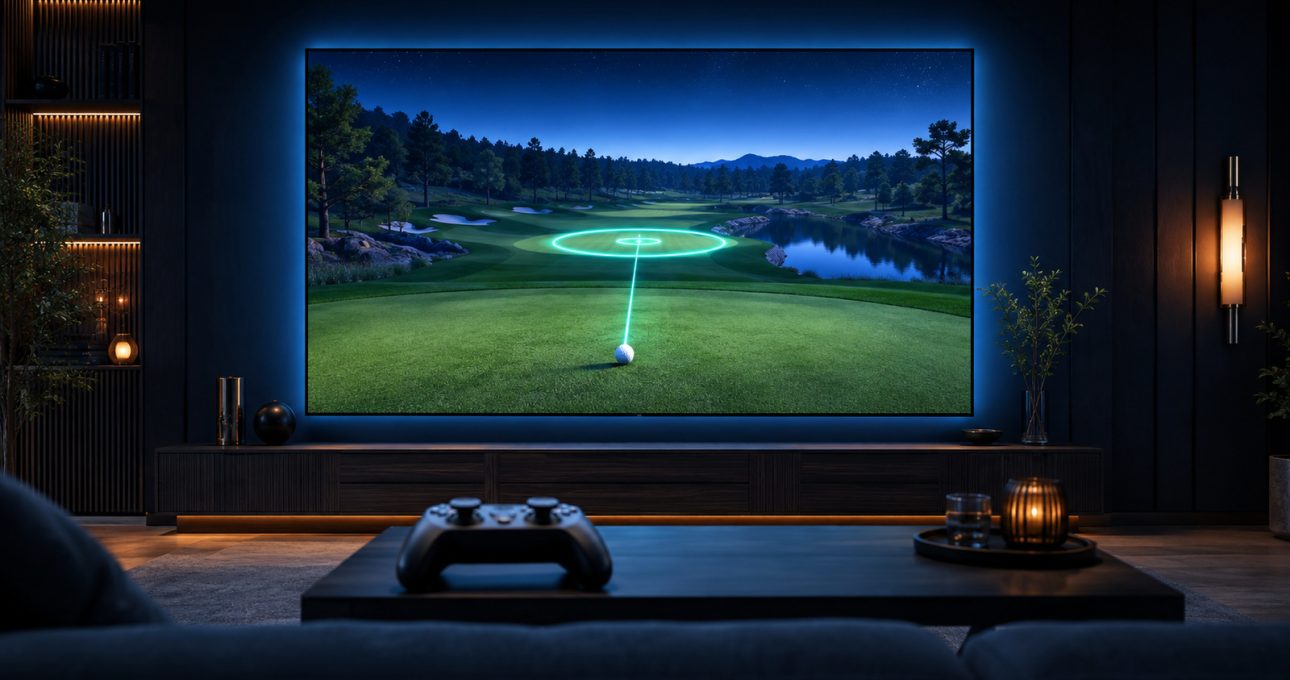
Golf Masters: 3D Championship can be read as a television-first golf design built around four public signals: 3D course presentation, an aim-and-shot control loop, solo and competitive modes, and progression through equipment or golfer customisation. The current edition is explicitly titled Golf Masters 3D: Android TV. That evidence supports an analysis of visible player-facing choices, but it does not reveal GameBee’s private design process, engine, code, testing results or internal intent.
This article is therefore not a developer interview or a private postmortem. It interprets the legacy product description and the current Android TV listing. Statements such as “appears designed to” are inferences from those sources, not quotations from an unreleased design document.
A television setting changes the readability problem
On a phone, the player holds the display close and usually touches the same surface that shows the action. On Android TV, the player sits farther away and uses a separate input device. That creates a basic interface challenge: the target, ball, direction and result need to remain legible at living-room distance.
The store’s emphasis on Android TV optimisation and high-quality 3D course presentation suggests that screen context is part of the product identity. It does not prove a particular resolution, frame rate or performance level. Those properties vary by device and would require direct technical evidence.
From a player perspective, good readability can be evaluated without reverse-engineering the product. Are the next objective and aim direction easy to locate? Can important feedback be distinguished from decorative scenery? Does the camera help the player connect an input with the ball’s result? These are observable questions for the installed edition.
The control loop compresses golf into a few decisions
The public sources name drag-and-release in the legacy material and aim, angle adjustment, swing and putt in the current store. That combination indicates a loop focused on selecting direction and executing a shot rather than reproducing every physical movement of real golf.
On television, a compact loop can reduce the number of simultaneous commands a player must remember. It may also make a session easier to begin from a sofa. This is an interpretation of the named actions, not a claim that the controls are objectively simple for every person or input device.
Exact mapping remains an edition-level fact. A remote, gamepad or other supported controller may present the actions differently. The public material reviewed here does not justify a universal button diagram, so the installed tutorial should remain the source for operational instructions.
Feedback connects a shot with the next choice
Any aim-and-swing system needs feedback strong enough for the player to learn. The result should help distinguish a directional mistake from an execution or distance mistake. Course visuals, camera movement and landing position can all contribute to that understanding.

The public descriptions do not explain the underlying simulation or calculation. It would be misleading to claim a specific physics model, wind system, terrain response, spin system or ball algorithm. “Realistic” is promotional language in the first-party copy, not an independently verified technical specification.
An evidence-safe design analysis therefore stays at the interaction level. The player chooses, acts, observes and adjusts. Whether that loop feels fair or satisfying is a matter for direct experience and can vary with device, controls and expectation.
Solo, tournament and multiplayer modes serve different sessions
The Android TV listing names single-player challenges, tournaments and multiplayer matches. Those modes appear to create three session frames. Solo challenges can support practice or a self-contained objective. Tournaments can group performance into a larger competitive arc. Multiplayer can add another person’s decisions or results.
Mode labels do not reveal every rule. The evidence does not fully define matchmaking, synchronous or asynchronous behavior, bracket structure, entry conditions, connection requirements or ranking cycles. An article should not fill those gaps with conventions from other sports games.
From a design perspective, the important public fact is variety of context around the same core actions. Aim, swing and putt can be reused while the stakes and comparison change. Reuse can help a player carry learned controls between activities without implying that every mode is mechanically identical.
Customisation adds persistence beyond one round
The store describes unlockable equipment, gear upgrades, golfer personalisation, outfits and accessories. These features provide a layer of longer-term choice beyond the immediate shot. A player may return to pursue a visual preference, a stated equipment effect or another progress goal.
The distinction between cosmetic and functional items must come from the installed labels. Public copy does not supply a complete stat table, economy or unlock schedule. It also does not establish that purchases are required. Google Play discloses in-app purchases, so commercial choices should be evaluated separately from the existence of progression.
On a shared television, profile and purchase boundaries may be particularly relevant. The sources do not confirm account sharing or household profiles, but a user can still configure device-level authentication and review who is allowed to transact.
Daily challenges create a compact return structure
The legacy product description mentions daily challenges and achievements. A daily objective can give a returning player a clear starting point without requiring a long tournament. It can also direct attention toward a specific part of the game.
This should not be overstated as a retention result. No approved analytics or behavioral study was supplied. The existence of a daily challenge is a feature claim; the effect on engagement is an empirical question that would need measured evidence.
For player-first guidance, daily content should remain optional. A session can be built around the time and goal a person chooses, rather than an obligation to collect every reward.
Platform adaptation should be described as an edition, not a promise
The current product title makes the Android TV scope explicit. That is stronger evidence than a generic assumption that any Android game will work on a television. It also creates a boundary: this listing does not establish iPhone, mobile Android, Fire TV or another platform under the same product.
An edition-specific approach protects players from three common assumptions. Availability on multiple screens does not prove cross-save. A purchase on one platform does not automatically unlock another package. A feature described in one listing does not automatically exist in a different build.
The same care separates Golf Masters from Golf Pro Tour 3D: Multiplayer, another GameBee golf identity. Similar genre and vocabulary do not make the products interchangeable. Current claims in this analysis are anchored to the package identifier `com.gamebee.androidtv.golfstrike`.
What would strengthen a future technical account
A deeper authority article would need approved first-party evidence beyond promotional descriptions. Useful material could include a named developer or designer interview, authentic control diagrams, device-testing scope, accessibility notes, performance targets, before-and-after interface examples and a clear explanation of which decisions apply to which build.

Such evidence would allow GameBee to replace inference with attribution. A technical statement could identify who made it, which version it covers and how it was validated. Screenshots could demonstrate the interface without fabricating a private wireframe.
Until then, restraint is a strength. The current evidence supports a useful analysis of player-facing patterns while leaving engine, code, internal workflow, testing and unannounced plans unspecified.
Public-evidence questions about Golf Masters design
Is this an official developer postmortem?
No. It is an editorial analysis of GameBee’s public product and store descriptions. No private design document, developer interview, source code, engine profile or internal test report was supplied for this article.
Why does the Android TV edition need separate treatment?
Television play changes viewing distance and separates the display from the input device. More importantly, the exact store title and package identify a specific edition. Its compatibility, controls, features and purchases should not be inferred from a mobile or similarly named golf game.
Does the evidence prove realistic golf physics?
No. First-party descriptions use realism language, but the reviewed sources do not document a physics model or independent test. This analysis discusses the observable aim–act–observe loop and makes no technical simulation claim.
What evidence would support stronger design claims later?
An approved named interview, authentic control material, version-specific screenshots, device-test scope, accessibility documentation and measured performance evidence would support more precise attribution. Each item should identify the build and context it covers.