
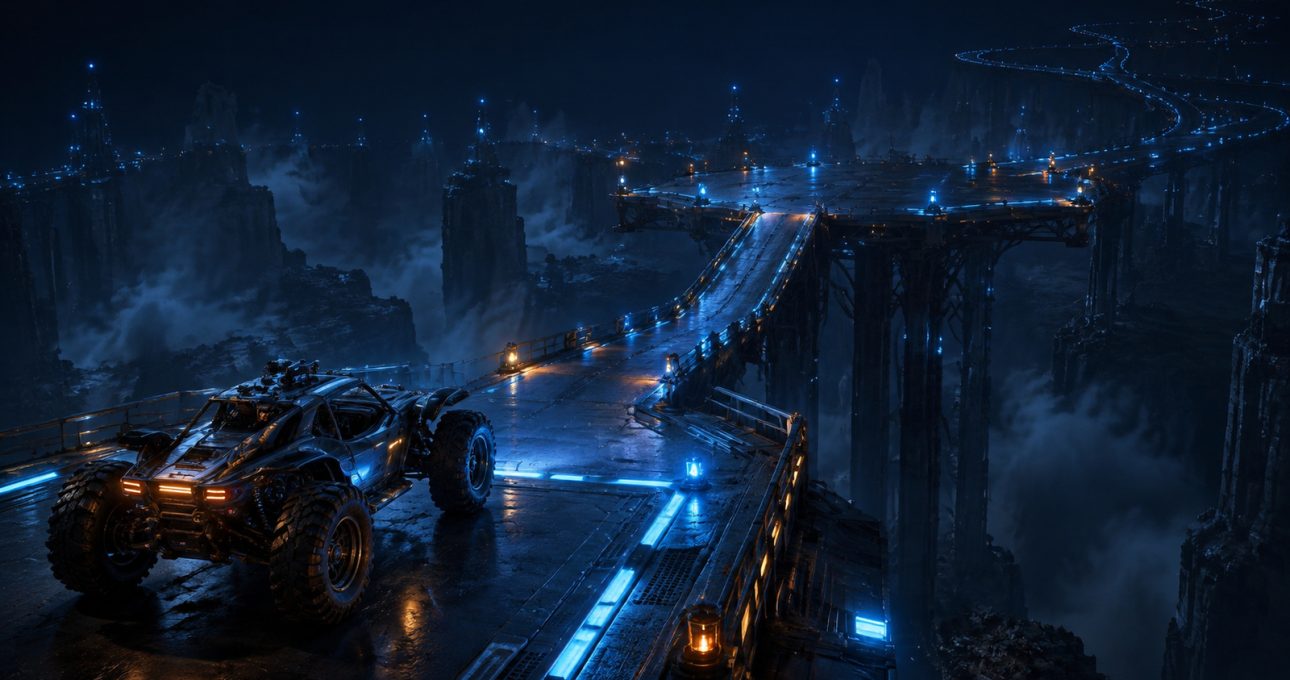
Clearing an elevated ramp in Extreme Car Stunt 3D depends on the approach that happens before take-off. GameBee's live Extreme Car Stunt 3D product profile documents mega ramps, sky tracks, arcade stages and several broad vehicle types. It does not publish fixed control labels or a physics specification, so the safest improvement method is to read the current edition, make one measured change and compare the landing.
This guide cannot guarantee a clear because vehicle response, stage geometry and input options can vary. It offers a repeatable diagnostic process: understand the target, align early, test speed in small steps, minimise conflicting corrections and judge the result at touchdown.
Read the entire gap before pressing for speed
Pause long enough to identify the take-off edge, the landing platform and the direction the track continues. Look for height difference, lateral offset, narrowing surface and any turn immediately after touchdown. A jump is not solved by distance alone; reaching the far side with no usable continuation can still end the attempt.
If a preview or camera angle is available in the current build, use it only as the game presents it. Do not assume a hidden landing area from artwork. The objective, checkpoint marker and visible track should decide where the vehicle needs to arrive.
Establish the centre line well before take-off
Late steering near a ramp can send the vehicle across the edge at an angle. Start by placing it near the centre of the available surface while there is still room for a gentle correction. Then reduce steering changes as the take-off point approaches. A straight launch usually preserves more of the landing width.
Use two visual references: one close to the vehicle and one near the centre of the far platform. If those references remain aligned, the approach is likely stable. If the far target drifts sideways, correct early and gradually instead of snapping the steering input at the lip.
Create a baseline speed instead of guessing maximum power
The first attempt should answer a question, not merely chase a success. Choose a moderate, repeatable acceleration pattern and observe whether the vehicle falls short, overshoots or reaches the landing zone. On the next attempt, alter the start point or acceleration duration slightly while keeping alignment and vehicle choice unchanged.

This process turns speed into useful evidence. Full acceleration may be appropriate for one gap and excessive for another. The legacy description does not state that every ramp requires maximum power, so a controlled test is more reliable than a universal rule.
Separate approach errors from take-off errors
When a jump fails, identify the earliest moment the attempt moved away from plan. An approach error begins before the ramp: the vehicle is off-centre, still turning or carrying inconsistent speed. A take-off error appears at the edge, perhaps after hitting the ramp crooked or making a sudden input.
Fix the earliest cause first. Trying to rescue a poor approach in mid-air can hide what needs to change. If the vehicle leaves the ramp cleanly but misses by a consistent distance, speed is a more plausible variable. If it rotates or drifts sideways immediately, alignment deserves attention before power.
Keep airborne corrections limited and deliberate
The public profile does not document aerial controls. Use only prompts and behaviour confirmed in the current edition. If steering affects the vehicle in the air, apply a small correction and observe the result; do not assume a control scheme from another stunt game.
Multiple opposing inputs can create uncertainty because it becomes unclear which action changed the landing. When the launch is straight, holding a calm input may be better than trying to add spectacle. A successful stunt is the one that satisfies the visible objective, not necessarily the one with the most rotation.
Prepare the vehicle for the landing surface
Watch the landing zone rather than the vehicle alone. The important questions are where the wheels will meet the surface, whether the body is aligned with the track and how much room remains for the next action. If the game exposes a safe way to influence attitude, make small changes early enough to settle before contact.

After touchdown, avoid combining hard steering, braking and acceleration immediately. Let the vehicle establish contact, then guide it toward the continuation. A landing that looks less dramatic but leaves stable control is more useful than one that barely catches an edge.
Adapt the method when a different vehicle is available
GameBee names monster trucks, vans and fast cars, but it does not publish comparative statistics. Do not assume that one class always jumps farther or lands better. Test the vehicles actually offered by the current edition on the same early ramp, using a similar start point and input pattern.
Note differences in steering response, visual position and recovery, then choose the option that is easiest to repeat. If a vehicle is locked, do not infer the unlock condition or promote a purchase. Follow only the progression and commercial information visible in the game and its active store record.
Recover calmly after a failed jump
If the game provides a restart or checkpoint, use the documented control rather than continuing with a vehicle in an unusable position. A quick, consistent reset makes comparisons more reliable. Record the cause in a few words: short, long, left, right, unstable at take-off or unstable at landing.
Change one element on the next attempt. Moving the start point, changing the vehicle and steering differently at the same time prevents a clear diagnosis. Three controlled attempts can reveal more than many random retries.
Use a five-attempt practice cycle
Attempt one establishes a conservative baseline. Attempt two adjusts speed. Attempt three refines centre-line alignment. Attempt four repeats the best combination without adding a new action. Attempt five tests whether that combination still works when performed deliberately. If the last two land similarly, the method is becoming repeatable.
Move to the next stage only when the current result can be explained. The goal is not perfection on every run; it is knowing which input produced a useful change. That knowledge transfers as a process even when the next ramp has different geometry.
Keep the stunt inside the game
Sky ramps and vehicle jumps are fictional arcade challenges. They are not instructions for driving on public roads, private property or real stunt equipment. Do not attempt to recreate them with an actual car, van or truck.
For current product access, use Amazon record B09MRQX5X7 and confirm device eligibility at the time of action. Players who want to compare a separate GameBee stunt identity can inspect Super Wheels; its controls and stages must be learned independently.
Extreme Car Stunt 3D landing questions
Why does the vehicle keep leaving the ramp sideways?
It may still be turning near the take-off edge. Centre the vehicle earlier, use a distant alignment reference and reduce last-second steering before changing speed.
Should every sky ramp use maximum acceleration?
Not necessarily. The public description gives no universal power rule. Establish a repeatable baseline, observe the distance and adjust in small steps for the visible gap.
Which vehicle is best for landing?
No verified public statistics establish one best choice. Compare only the vehicles offered in the current edition on the same section and favour the response you can reproduce.
What should change after a failed attempt?
Change one variable tied to the earliest error: alignment, start point, acceleration duration or a confirmed airborne input. Keep the other conditions stable so the next result is meaningful.