
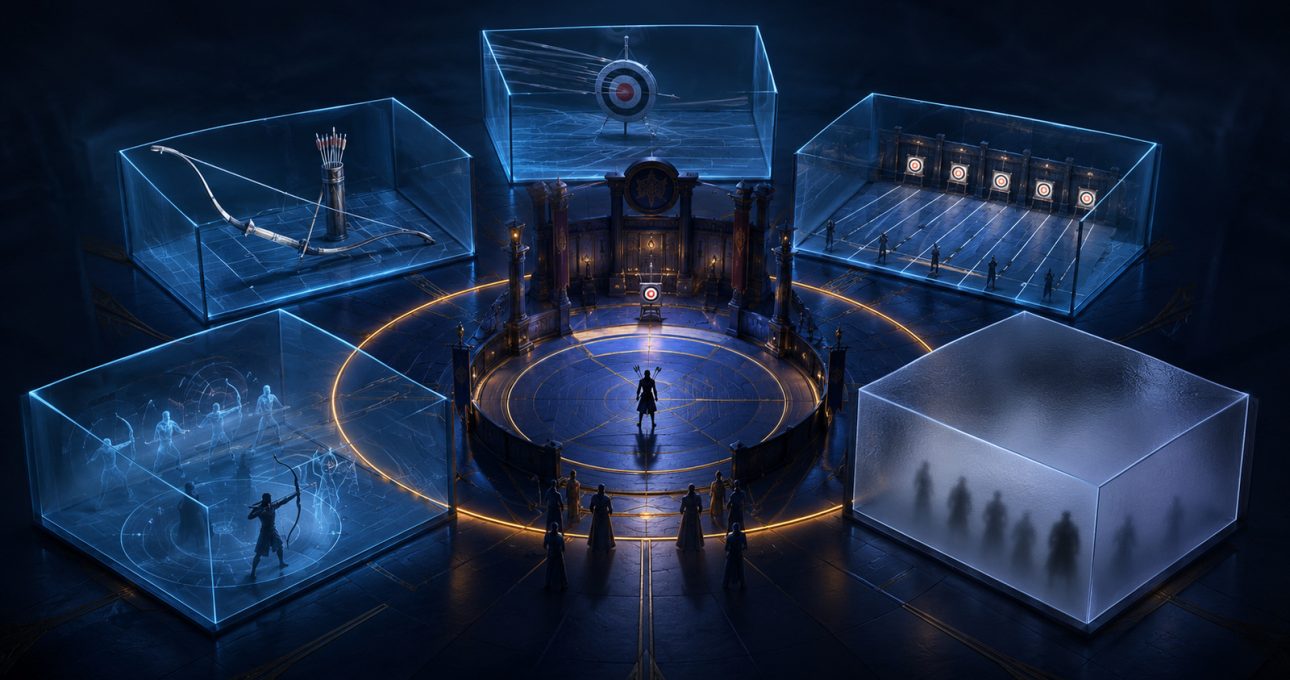
Archery Arena's public design can be analysed through what the current Apple edition asks players to do: aim, release, read physics, respond to moving or distant targets, improve equipment and move between offline practice and real-time competition. The Apple source for ID 6756249425 is detailed enough to define those visible systems.
It is not a developer interview or production archive. It does not explain why a feature was selected, how prototypes changed or which feedback led to a release. This analysis therefore separates observable design consequences from private design decisions and identifies what evidence would be needed to close the remaining gaps.
Public evidence supports analysis, not an insider account
A store description can establish a feature, platform claim or commercial condition when it is tied to the exact product identifier. It cannot establish team intent. Saying that moving targets require anticipation is an analysis of the documented mechanic; saying the team added them to satisfy a named audience would require a source.
The same rule applies to version notes. A public bug-fix label establishes maintenance activity, but it does not identify the defect, affected device or measured outcome. Transparent boundaries make the article useful because readers can distinguish current facts, reasonable observations and unanswered development questions.
The shot cycle reveals the primary control priority
Apple emphasizes smooth aim controls and physics-based shooting. Together, those claims make control predictability the most important visible design test. The player needs to connect an aiming movement and release to a result before higher-level challenge types can feel fair.
Moving targets, long-distance shots and time limits then place different pressures on the same cycle. That reuse can support learnability: the player is not learning an unrelated interface for every challenge. The public evidence does not expose sensitivity settings, assist systems or the exact simulation model.
PvP and tournaments introduce comparative pressure
Real-time duels make the shot loop social and time-sensitive. Even without a published ranking model, competition changes how an error feels because the player's result is compared with another performance. Clear scoring and event rules become especially important under those conditions.
The listing also names leaderboards and seasonal events, showing a broader competitive frame. It does not document event cadence, matchmaking, anti-cheat systems or reward distribution. Those areas should be evaluated from the live event interface rather than filled with standard assumptions about mobile PvP.
Offline support broadens the practice context
Offline and online modes allow the same product identity to address different session needs. Offline practice can reduce network dependence, while online play carries the verified duel and tournament context. This division may help players learn before exposing a developing routine to competitive pressure.
The source does not map every activity to a network condition. A responsible platform analysis asks which modes launch offline, whether prior activation is needed and how progress behaves after reconnection. Those questions require the installed build and should not be answered from compatibility language alone.
Gear creates a visible progression layer
Unlockable bows, arrows and equipment give the skill loop a collection and progression context. They can help the game present medium-term goals beyond one target. The store text does not provide complete stats, rarity rules, upgrade costs or proof that equipment determines competitive success.
Because the edition includes advertising and purchases, progression analysis must distinguish play-earned unlocks, paid offers and subscriptions as shown at the time of use. A public item list is not enough to infer the economy or fairness of a tournament without acquisition conditions and visible effects.
Version history supports maintenance, not motive
The captured Apple history shows labels 1.0, 1.0.1 and 2.1 with brief bug-fix wording for the later entries. The month and day are visible, but the history view does not display years for those rows. A dated ledger should preserve exactly what the source shows.

A jump in version numbering does not reveal the scale of gameplay change by itself. The visible notes do not name a new mode, control revision or measured performance improvement. Future analysis should add only version-specific claims that appear in an approved changelog or repeatable test.
Apple compatibility defines the current adaptation record
The product is designed for iPad and available for iPhone and iPad under iOS or iPadOS 13.0 and later. Apple also lists Apple-silicon Mac and visionOS compatibility, while explicitly stating that the app is not verified for macOS. This is a compatibility range, not proof of equal optimization.

Platform adaptation should be assessed through input size, target visibility, orientation, readable interface elements and session stability on each device. The current listing does not establish Apple TV or Android availability. Any broader platform statement must use another exact edition approved for the P32 identity.
What future first-party evidence would complete the story
A true development history would need dated first-party material such as a design brief, interview, prototype comparison, release changelog or attributed player-research summary. Each source should connect one decision to a stated goal and identify the edition or version affected.
Until that material exists, the strongest authority asset is a transparent design analysis: exact product ID, documented features, observable player consequences, current platform qualifications and explicit unknowns. That approach provides depth without turning promotional text into a fictional behind-the-scenes account.
Keep the analysis versioned and edition-specific
Every future revision should retain the Apple ID, observation date and visible version label beside a material claim. If another store edition is confirmed, its mechanics, commercial terms and compatibility should be recorded separately until first-party evidence establishes equivalence.
This discipline makes the article easier to maintain when a description, mode or compatibility line changes. It also prevents an older bug-fix note or a feature from another platform from silently becoming a permanent statement about every Archery Arena release.
Read the source-bounded Archery Arena review for the current mechanics, competitive context and player-fit verdict.
Questions about Archery Arena design evidence
Is this an official Archery Arena development story?
No. It is an evidence-led analysis of the public Apple description and version history. It does not claim access to prototypes, internal meetings or developer motives.
What design priority is most visible in Archery Arena?
The public evidence makes a readable aim-and-release cycle central because moving targets, distance, time limits and PvP all depend on predictable control feedback.
What do the visible bug-fix notes prove?
They prove that maintenance notes were published for the listed versions. They do not identify the repaired defect, affected device, cause or measured performance gain.
What evidence is needed for a real development history?
Use dated first-party interviews, design documents, prototype comparisons, detailed changelogs or attributed research that connects a specific decision to a documented goal.