

Reliable stunt runs in Car Stunt Extreme begin before the vehicle leaves the ramp. The Car Stunt Extreme product profile identifies timed racing, drifting, 360-degree flips, FPP mode and nitro as parts of the experience. The current Amazon edition remains the authority for the exact inputs available on the intended device.
These tips stay inside the game. They are not real-world driving or stunt guidance, and they do not assume a particular button layout or physics value. The aim is to help players observe approach speed, alignment, rotation and recovery in the installed edition, changing one variable at a time.
Establish a clean run before chasing a stunt
Begin with an attempt that prioritises reaching the finish or next checkpoint without an unnecessary flip or boost. A clean baseline shows how the vehicle accelerates, how quickly steering takes effect and how much space is available after landing. Without that reference, a failed stunt can be blamed on the wrong cause.
Use the same camera and vehicle while learning the section. If the current edition offers several choices, changing them together makes comparison less useful. Once the basic line is repeatable, add one stunt element and judge whether it improves the objective shown by the game.
Read the entire ramp before accelerating
Look from the start of the approach to the visible landing area. Note whether the take-off surface is straight, angled, narrow or followed by an immediate turn. The ramp shape determines how much steering correction can be completed safely before the vehicle becomes airborne.
Accelerating first and deciding later often produces a diagonal launch. Instead, settle the vehicle near the centre of the available surface, reduce unnecessary steering movement and then build the speed needed for the jump. The exact amount must come from observation because the public material does not publish numerical speed targets.
Make the take-off line as square as possible
A vehicle that reaches the ramp at an angle is already rotating before any airborne input. That can be useful for a planned manoeuvre, but it makes a straightforward landing harder. For a clean jump, align the vehicle with the centre of the intended landing area and finish the largest steering correction on the ground.
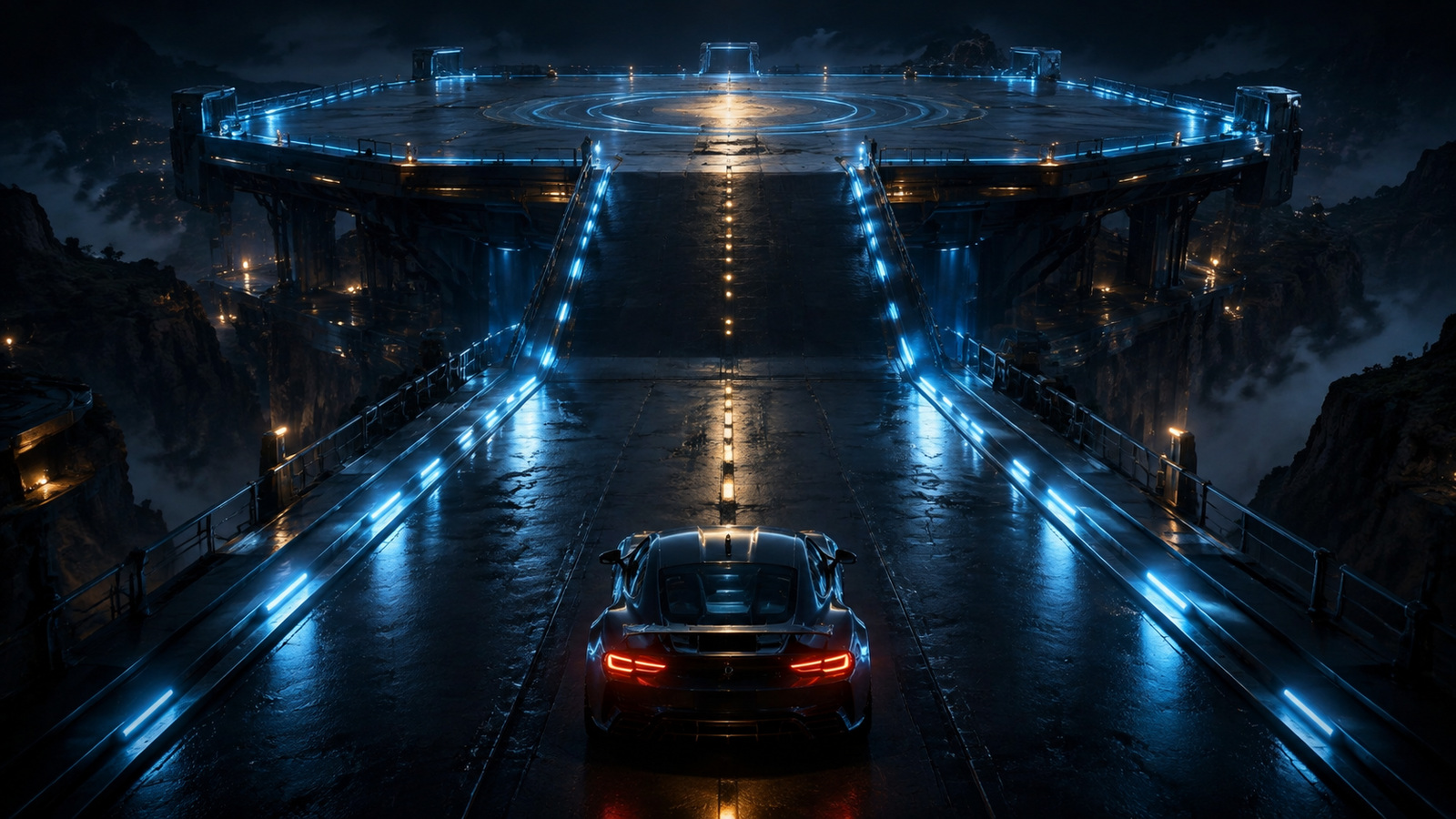
Use a visible edge, centre stripe or object as a reference if the current track provides one. Repeat the approach and adjust in small steps. When the landing keeps missing to the same side, correct the earlier line rather than adding increasingly large mid-air inputs.
Treat airborne correction as a limited resource
The website supports 360-degree flips, but it does not explain every control or rotation rule. In the installed build, test airborne input on a wide, forgiving jump before using it in a timed sequence. Learn whether the vehicle rotates continuously, responds in pulses or changes orientation through another prompt.
Once committed to a full rotation, watch the vehicle's underside, roofline or wheels as a visual reference. The goal is to return toward a stable landing orientation with time remaining for only a small correction. Repeatedly reversing input can create uncertainty and make the final angle harder to predict.
Prepare the landing before the vehicle descends
Do not wait for contact to decide where the vehicle should point. As the peak of the jump passes, identify the direction of travel after touchdown. Aim to bring the wheels toward the surface and the vehicle's nose toward the next usable section rather than toward the edge of the landing zone.

After contact, allow the game to register the landing before making a large steering change. A rapid correction can turn a recoverable touchdown into a spin. If the current build shows a stunt or landing result, use that feedback together with whether control was preserved for the next decision.
Separate drift practice from jump practice
GameBee names drifting as another stunt element, but drift entry, continuation and exit occur on the ground. Practise them on a familiar bend without a jump immediately afterward. Focus first on where the car begins to rotate and whether it can be straightened before the next obstacle.
When drift recovery is consistent, connect it to a ramp only if the track design requires the combination. A drift that looks dramatic but leaves the car angled across the take-off surface is usually a poor foundation for a controlled jump. The exit matters more than the length of the slide.
Use nitro to support a known line
Nitro can add momentum, but it should not be the first correction for a missed ramp. Confirm the line at ordinary acceleration, then test the boost from the same point and observe the difference. This isolates whether extra speed is actually needed or simply reduces the available reaction time.
If nitro has a visible meter, duration or cooldown in the current edition, build the decision around that feedback. Save it for a straight approach, a clearly distant landing or another objective that benefits from acceleration. Do not assume that the name alone guarantees a fixed effect.
Compare FPP and external views deliberately
FPP can make the centre of a ramp easier to target because the player's view aligns with the vehicle's forward direction. An external camera can show wheel position, lateral drift and rotation more clearly. Neither perspective is universally better; each solves a different reading problem.
Learn a section externally, then repeat it in FPP without changing the line. If performance changes, identify whether the cause is speed perception, reduced side awareness or input timing. Use the view that makes the next cue most visible rather than the one that merely feels faster.
Follow a focused ten-attempt practice cycle
Use attempts one and two to learn the unboosted line. Use three and four to adjust the centre of the approach. Use five and six to test one airborne correction. Use seven and eight to connect the landing with the next section. Reserve nine for a controlled nitro test and ten for a complete run using only the changes that proved repeatable.
Afterward, record one success and one failure in simple terms: approach angle, insufficient distance, excessive rotation or unstable recovery. That diagnosis creates a useful next session. Players seeking another style of stunt challenge can compare the live Super Wheels profile; those wanting a different racing focus can inspect Master Racer.
Car Stunt Extreme control questions
How much speed is needed for a ramp?
No universal numerical target is published. Start with a clean centred approach, observe whether the vehicle reaches the landing area, and adjust speed in small steps while keeping the camera, vehicle and line consistent.
Should nitro be activated before every jump?
No. Use it only after the ordinary line is understood and extra momentum serves a visible objective. A boost can magnify a poor angle and reduce the time available for correction.
Is FPP the best view for landing?
FPP can improve forward alignment, while an external view can reveal rotation and lateral position. Test both on the same familiar jump and choose the perspective that makes the relevant cue easier to read.
What should be corrected after a failed stunt?
Name the earliest cause: approach line, take-off speed, excessive rotation or late landing preparation. Change that one factor first instead of adding several new inputs to the next attempt.