
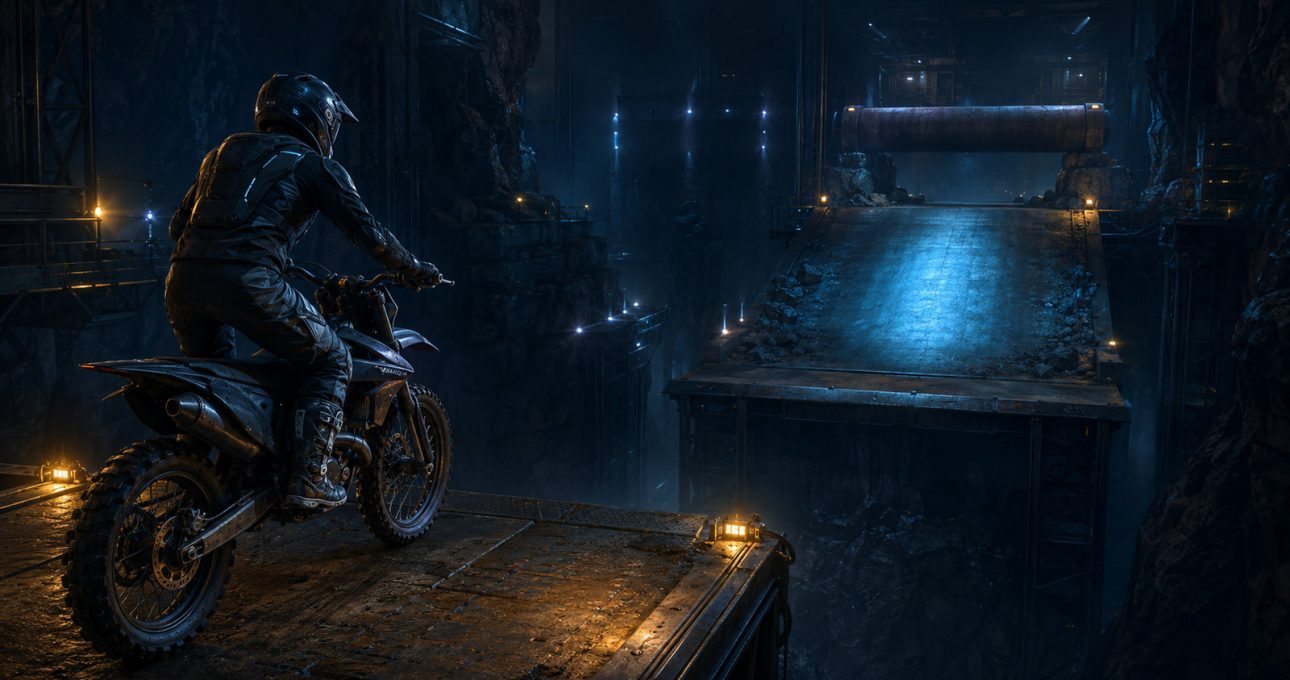
Landing consistently in MR Biker requires the approach, rotation and touchdown to work as one sequence. GameBee's MR Biker game profile establishes the game identity, and the verified Bike Stunt 3D TV listing documents jumps, flips, spins, airtime, varied off-road terrain, simplified television controls and upgradeable dirt bikes.
The current Apple listing does not publish exact buttons, physics values or a universal trick list. Follow the prompts in the installed Apple TV edition and use this method to diagnose decisions. It applies to game inputs only and is not real-world motorcycle guidance.
Learn the control response on level ground
Before attacking a large ramp, spend a short attempt observing how the current build responds to acceleration, steering and any balance or rotation input it presents. Make one small adjustment, release it and notice how quickly the bike settles. This creates a reference for later airborne corrections.
Do not begin by combining maximum speed and maximum rotation. When several inputs happen together, a failed landing does not reveal which one caused the problem. A controlled baseline makes each later change easier to understand.
Read the landing area before the ramp
Look beyond the take-off edge. Identify the centre of the landing surface, its direction and any obstacle immediately after it. A rider who sees only the ramp may launch with the wrong alignment and discover the landing too late.
Use the approach to place the bike toward the intended centre. If the current environment includes a narrow platform, slope or uneven surface, reduce unnecessary steering close to take-off. Stability at the ramp is often more valuable than a last-second attempt to collect an optional item.
Separate approach speed from trick rotation
Approach speed controls distance and airtime, while rotation determines the bike's orientation. Change only one of those variables between attempts. If the bike falls short but lands level, add speed in a small step. If it travels far enough but over-rotates, reduce or end the rotation earlier.
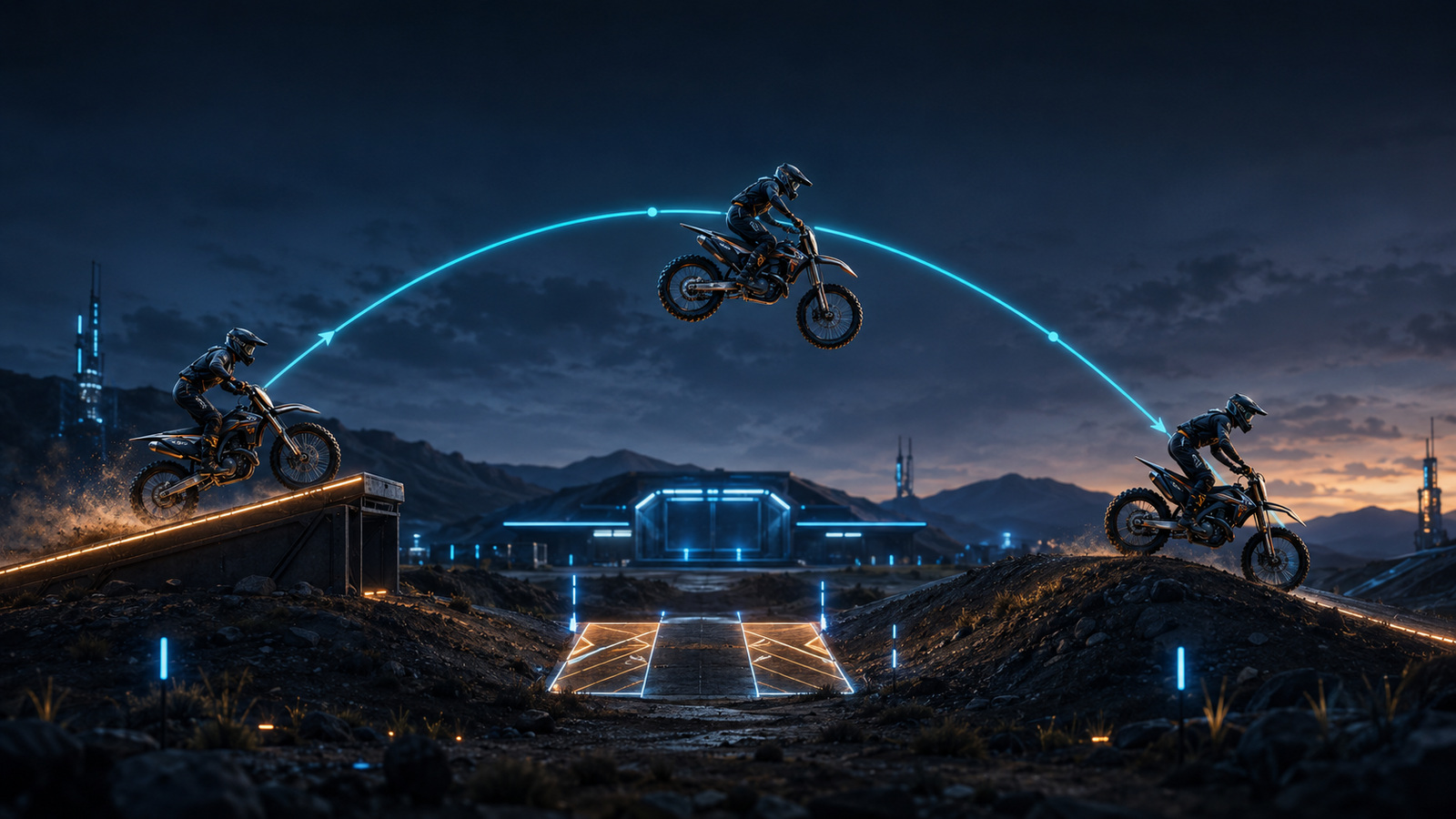
This separation turns a dramatic failure into useful feedback. Repeating the same mistake at a higher speed usually makes the result harder to read rather than easier to fix.
Begin rotation after a stable take-off
The Apple description confirms flips and spins, but it does not define their exact timing. Use the current prompts and start with a modest rotation after the bike has left the ramp cleanly. An unstable take-off followed by a large trick gives little opportunity to recover.
Watch the bike's orientation relative to the landing. If the build allows rotation to be reduced or reversed, use the smallest correction needed. Avoid constant input when the bike is already approaching a level position.
Prepare the landing before reaching the ground
Do not wait for impact to think about touchdown. As the bike descends, reduce excess rotation and align it with the landing direction. A stable landing is one that allows the next movement to begin without a violent correction.
If the bike hits nose-first or rear-first, identify whether the rotation continued too long or the approach created unexpected airtime. Correct that cause on the next attempt. Random changes to speed, bike and trick choice can hide the pattern.
Use smaller tricks to map a new environment
Muddy swamps, rugged mountains, dockyards and construction zones are named in the current store description. A new environment can change visual references, ramp spacing and the amount of time available to prepare. Use simple jumps first to learn its rhythm.
Once the common landing shapes are familiar, add a flip or spin where there is enough airtime. Exploration and performance do not need to happen at the same moment. A clean survey attempt can save several failed stunt attempts.
Treat each mission as a chain of recoverable sections
The store language refers to harder missions as stunt demands increase. Instead of trying to perfect the entire sequence immediately, find the section that ends most attempts. Practise reaching it with enough stability, then focus on the specific ramp or terrain transition.
When a landing is imperfect but recoverable, prioritise control over an extra trick. Preserving the attempt can reveal the next obstacle and reduce the need to repeat earlier sections.
Match upgrades to a visible limitation
MR Biker supports bike selection, customisation and upgrades. Before spending coins or considering a store item, name the limitation shown in play. A missed landing caused by late rotation may not be solved by a different bike. A visible performance cap may justify comparing attributes in the current build.
Change one bike element and repeat a familiar challenge. If the result improves consistently, the adjustment has useful support. If not, return to the approach and landing method before adding another purchase.
Adapt practice to Apple TV play
The verified current edition is Apple TV and promotes simplified living-room controls. Sit where the landing area and small terrain changes remain clear. Confirm the active controller and input prompts, because this guide does not assume a particular button layout.
Connection is recommended by the store for updates and customisations. Complete installation and restore any purchases before a focused practice session so account tasks do not interrupt the control test.
Use a repeatable ten-attempt drill
On attempts one and two, cross the ramp without a trick and study distance. On attempts three and four, adjust speed only. On attempts five through seven, add one modest rotation and end it early enough to prepare the landing. Use the final attempts to repeat the most stable combination.

Record the cause of each failure with one phrase: short, long, under-rotated, over-rotated or misaligned. A clear label is more useful than saying the game felt difficult. Players interested in a different motorcycle format can inspect Stunt Extreme 3D; it remains a separate game with separate controls.
MR Biker stunt questions
Why does the bike keep over-rotating?
The rotation input may be held too long for the available airtime. Keep the same approach speed, end rotation earlier and prepare a level touchdown. Confirm the exact control response in the current build.
How can a player avoid falling short of the landing?
First confirm that the take-off is straight and the bike is not losing momentum through late steering. Then increase approach speed in small steps while keeping the trick rotation unchanged.
Should upgrades be purchased before learning the controls?
Not automatically. Use the available bike to identify whether the limitation is input timing, alignment or a visible bike attribute. Review current purchase terms only after a specific need is clear.
Are these instructions valid for real dirt-bike riding?
No. They describe a video-game practice method based on the current Apple TV edition. Real riding requires professional instruction, protective equipment and a controlled environment.