
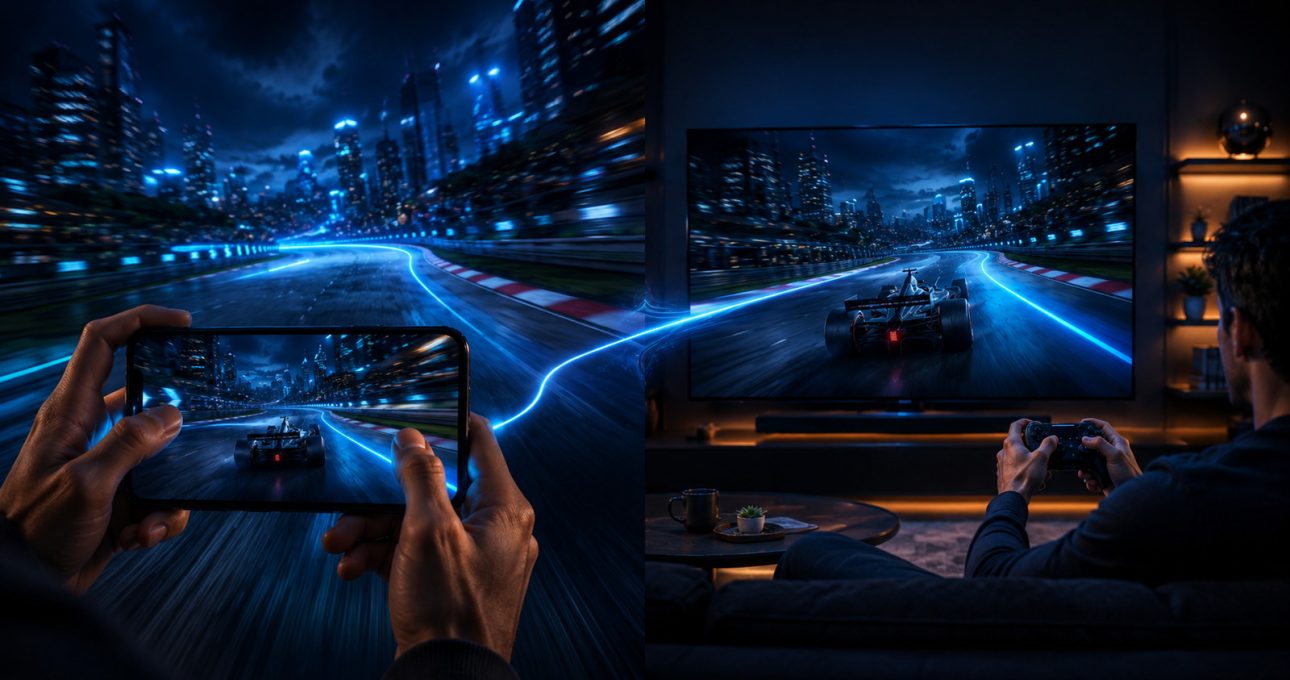
A racing game feels great when the player's input produces a readable response, the road communicates what is coming next, and the result explains what to try again. Mobile and television can both deliver that loop, but they do it through different screen distance and input conditions. GameBee's current Formula Racing, Stunt Extreme and Master Racer records provide public examples of precision, viewpoint, modes and big-screen presentation without requiring claims about private development methods.
This analysis uses public game and store descriptions, not private design documents, unpublished performance tests or promises for every device. “Feel” is partly personal. The evidence can identify what to inspect; the final judgement comes from the exact edition, controller and screen in use.
Response must connect action to movement
Steering feels coherent when a small input causes a proportionate change and the player can predict the next correction. Acceleration and braking need the same relationship. If the car appears to ignore an action or overreact without a visible reason, speed becomes noise rather than mastery.

The Formula Racing store record describes responsive controls, braking into sharp corners and maintaining control at speed. Those statements suggest the intended skill loop, not a guarantee on every television. Test a straight, a gentle bend and a tight corner with the intended input. Each should reveal a different but understandable response.
On mobile, touch sensitivity and hand position affect the test. On television, controller pairing, button mapping and wireless delay can affect it. Separate setup effects from the game's central handling before drawing a conclusion.
A track should reveal decisions before demanding them
Good track readability lets a player see the corner, obstacle or gap early enough to choose. It does not remove challenge; it makes the challenge attributable to judgement. Formula circuits can teach through repeatable braking points. Street layouts can use traffic and lane openings. Stunt courses can signal the alignment and speed needed for a jump.
Television gives the environment more physical space, but viewing distance can reduce the size of prompts. Mobile brings detail close, but interface controls may cover part of the view. Use the normal posture for the device. Ask whether the road surface, boundary and next hazard stay distinct at speed.
If a retry improves only because you memorised an invisible surprise, the experience differs from learning a visible decision. Both can be difficult, but only one produces dependable feedback.
Camera choice changes the sensation of speed
The current Stunt Extreme Apple listing names a first-person camera and real bike sounds. A close camera can make traffic and motion feel immediate, while a more distant view can provide wider spatial awareness. Neither is automatically superior.
Test whether the camera supports the task. A bike weaving through traffic needs enough forward information to choose a gap. A stunt landing needs a view that helps align the vehicle. A circuit needs stable reference points for braking and turn-in. If the edition offers camera choices, compare them using the same short section rather than relying on visual drama alone.
Audio can reinforce speed, engine effort or contact, but it should not be the only signal. Players may reduce volume or use a shared room. Essential outcomes should remain understandable through visual and control feedback.
Goals turn motion into a meaningful attempt
Driving quickly is more satisfying when the mode explains what success means. Master Racer's current Android TV description names Classic, Elimination and V/S modes. One emphasises traffic and upgrades, another adds a timer and missions, and another frames an opponent. That variety changes the decision even when the same vehicle is used.
A short goal helps players learn the controls. A longer career or garage gives repeated attempts context. The key is a visible next objective: finish, survive, beat a time, defeat a rival, clear an obstacle or improve a vehicle. Too many simultaneous currencies and prompts can weaken that clarity.
Before paying for an upgrade, check whether the base driving loop is already understandable. Progression should extend a satisfying action, not compensate for an unclear one.
Television needs legibility beyond visual scale
The current Master Racer and Formula Racing records are television editions. Their descriptions refer to television optimisation, smooth handling and high-definition or detailed presentation. Those are first-party positioning statements, not measured frame-rate evidence.
A practical living-room test checks four things: menu focus is visible, text can be read from the usual seat, the selected car and goal are unmistakable, and feedback remains clear during speed. A large screen can still fail if information is small or low-contrast. Conversely, a simple visual system can feel excellent when it makes the next action obvious.
Controller navigation is part of legibility. If focus disappears or a menu requires touch-like precision, the separation between screen and hands becomes a burden.
Mobile needs controls that respect limited space
On a phone, interface elements compete with the track for a compact display. A good mobile layout keeps essential input reachable without hiding upcoming hazards. It also prevents accidental actions when the player adjusts grip.
Use a short race to test whether your thumb position blocks the road, whether steering can be corrected without large gestures and whether pause or restart is easy to find. Tablet results may differ because the screen and hand span change. Do not turn one device test into a universal mobile claim.
Commercial prompts also affect rhythm. Review advertisements, purchases and subscription terms in the current store. A driving loop can be clear while the overall session still fails to match the player's tolerance for interruptions or payments.
Updates and reviews reveal questions, not blanket answers
Current first-party records show separate update histories for Formula Racing, Master Racer and Stunt Extreme. An update note such as bug fixes indicates ongoing package activity at that moment, but it does not prove perfect performance. Old notes can also remain visible after priorities change.
Player reviews can surface themes such as controller difficulty, smoothness, graphics, pricing or compatibility. Treat those themes as test prompts. A single review is not a technical diagnosis, and an aggregate score changes over time. Reproduce the issue on the intended device before describing it as a fact.
GameBee's public responses to feedback show a support path, but they do not prove that every reported issue is resolved. Current version, device model and date are necessary context.
Run a feel audit in one short race
Before a long mode, test input response, track anticipation, camera usefulness, feedback clarity, goal visibility and restart speed. Record one sentence for each. Then inspect compatibility, update notes and commercial terms. This converts “feels good” into a set of observable questions without pretending that personal preference can be reduced to one score.
Compare editions only when the same task exists on both. A formula lap and a traffic mission answer different needs, so their feel should not be ranked as though they were identical tests.
Racing-feel evidence questions
Does a high frame rate automatically make a racing game feel good?
No. Performance can matter, but input response, readable decisions, camera stability and useful feedback also shape the experience. This guide makes no universal frame-rate claim.
Why can the same racer feel different on television and mobile?
Viewing distance, input hardware, display size, interface placement and device performance all change. Separate packages may also have different modes, updates and commercial terms.
Are store descriptions enough to judge handling?
They identify the intended experience and verified features. Handling still needs a short test with the exact device and input because first-party positioning is not a personal control trial.
How should player reviews influence the choice?
Use recurring themes to form checks for your own device. Do not treat one review, an old version or a changing aggregate score as proof for every player.
Great feel makes improvement understandable
The strongest racing loop connects action, motion, environment, feedback and goal. Inspect those links in a current verified edition, whether it is Formula Racing, Stunt Extreme or Master Racer. When a retry teaches you something concrete, speed becomes progress rather than spectacle alone.